Add your promotional text...

Randomness is Divine
"God does not play dice with the universe." Einstein famously declared. What if he was wrong?
REFLECTIVE
7/7/20262 min read

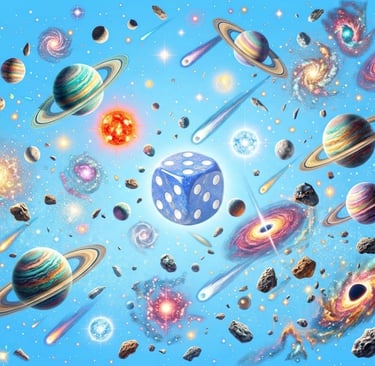
Einstein believed that beneath the apparent chaos of the world lay perfect order. If only we knew enough, he felt, every event would reveal its cause.
What if Einstein was wrong?
Modern physics has taken us in a different direction. At the quantum level, randomness appears to be woven into the very fabric of reality. Particles do not always behave according to certainty; they behave according to probabilities. Nature, it seems, does play dice.
But perhaps this debate misses a deeper question.
What if randomness itself is divine?
Human beings have always been uncomfortable with uncertainty. We crave prediction, control, and certainty. When things happen without an obvious cause—a chance meeting that changes our life, an unexpected opportunity, a sudden inspiration, or an unforeseen tragedy—we label them as "random."
Yet what appears random to us may simply be beyond the reach of our understanding
Ancient Indian wisdom offers an interesting perspective. Life unfolds through countless visible and invisible forces. The universe is not a construct assembled from predictable components; it is a living mosaic of infinite interactions. Our limited minds perceive only a tiny fraction of these connections.
Randomness, then, is not necessarily the absence of order. It may be the construct of a higher order that our intellect cannot fully comprehend.
Imagine standing one inch away from an immense painting. The brushstrokes appear chaotic. Step back, and a masterpiece emerges. The randomness was only an illusion created by limited perspective.
The famous example of illusion quoted in Upanishad about a snake and the rope. A rope seen from a distance may look like a snake, but as we approach near it the same turns into a rope!
Whether the universe is fundamentally deterministic or genuinely probabilistic may remain a question for physicists. But for ordinary life, randomness serves a profound purpose. It humbles us. It reminds us that we are participants in creation, not its masters.
Every great discovery has involved an unexpected observation. Every meaningful relationship has begun with an unpredictable encounter. Every spiritual journey starts when certainty gives way to wonder.
Perhaps the divine does not eliminate randomness. Possibly, the divine speaks through it. Or, is it that randomness itself is divine! Too shocking indeed.
Instead of fearing uncertainty, we might learn to welcome it—not as evidence that the universe lacks meaning, but as evidence that its meaning is greater than our present understanding.
Einstein searched for certainty because he trusted the intelligence of the cosmos. We can share that trust while also embracing randomness. Whether God plays dice or not may never be settled. But every throw of life's dice that we call chance invites us to grow in wisdom, humility, and faith.